Narrative Journeys That Leave a Lasting Mark

Comics thrive on momentum. While striking characters and iconic artwork draw readers in, it is the long-form narrative—the rise, fall, and transformation across multiple issues—that truly cements loyalty. Understanding Comic Story Arcs Fans Love the Most means exploring why certain narrative journeys resonate so deeply and continue to be revisited, discussed, and celebrated long after their publication.


The Power of Extended Storytelling

A story arc is more than a sequence of events. It is a carefully structured emotional and thematic progression.

Comics excel at serialized storytelling, allowing ideas to unfold gradually. Conflicts are layered. Consequences accumulate. Characters evolve in response to sustained pressure rather than isolated incidents.

This extended format gives readers time to invest. Emotional attachment grows issue by issue, creating anticipation and trust. When payoff finally arrives, it feels earned.

That sense of narrative fulfillment defines Comic Story Arcs Fans Love the Most.

Transformation as the Core

Manhwa and the Architecture of Visual Impact

Manhwa has become a defining force in contemporary visual storytelling, not solely because of its narratives, but because of its unmistakable visual authority. The medium speaks through color, composition, and rhythm with a precision that feels engineered for modern perception. This phenomenon is best understood through The Visual Power Behind Popular Manhwa, where art is not an accessory to story, but its structural backbone.

Unlike traditional print comics, manhwa is conceived with screens in mind. Every visual decision reflects an understanding of digital ergonomics. The result is an experience that feels immersive, fluid, and psychologically calibrated.

Digital Composition and Vertical Flow

The vertical-scroll format fundamentally reshapes visual composition. Panels are no longer confined to rectangular symmetry or page boundaries. Instead, they exist within a continuous spatial axis. This allows images to breathe. Motion unfolds downward. Time stretches visually.

A falling character may descend across multiple frames, elongating tension. A …

Manhwa and the Evolution of Narrative Form

Manhwa has emerged as a transformative force within contemporary visual culture, reshaping how stories are structured, delivered, and emotionally experienced. Once perceived as a regional medium, it now operates at the forefront of narrative innovation. Its influence extends beyond comics, affecting animation, streaming adaptations, and even interactive media. This shift offers a compelling lens into How Manhwa Changed Modern Storytelling.

The change did not occur abruptly. It was the result of gradual experimentation, technological alignment, and a willingness to challenge inherited narrative conventions.

Digital-First Story Architecture

One of the most profound changes introduced by manhwa lies in its digital-first architecture. Traditional page-based storytelling relies on spatial limitation. Manhwa dissolves this boundary. Vertical scrolling enables narratives to unfold continuously, unrestrained by page count or panel grids.

This structural freedom alters pacing at a fundamental level. Moments can stretch across screens. Silence becomes palpable. Emotional beats are elongated through visual descent …

Manhwa and Manga in a Global Context

Manhwa and manga are often mentioned in the same breath, grouped together as pillars of East Asian sequential art. Yet beneath this superficial proximity lies a complex divergence in structure, aesthetics, and narrative philosophy. Understanding these distinctions reveals not competition, but contrast. It also clarifies Manhwa vs Manga What Sets Them Apart in a rapidly globalizing comics ecosystem.

Both forms share historical intersections with print culture and visual storytelling traditions. However, their modern expressions reflect different creative priorities shaped by technology, readership habits, and cultural frameworks.

Origins and Cultural Frameworks

Manga developed within Japan’s postwar publishing boom, deeply rooted in serialized print magazines. Its evolution was shaped by rigid publication schedules, black-and-white printing economics, and genre segmentation aimed at specific demographic cohorts. These constraints fostered remarkable efficiency in storytelling, emphasizing clarity, symbolism, and visual economy.

Manhwa, originating in South Korea, followed a more turbulent trajectory. Subject to censorship during much …

Manhwa and the Digital Renaissance of Visual Storytelling

Manhwa has undergone a remarkable transformation over the past two decades, shifting from a nationally consumed medium into a global cultural export. This evolution did not occur in isolation. It was catalyzed by technological change, shifting reader behaviors, and the emergence of digital platforms that redefined how stories are created and consumed. Together, these forces explain The Rise of Manhwa in the Digital Age and its growing dominance within contemporary comics culture.

Unlike traditional print-bound comics, manhwa adapted early to screen-based reading. Creators began designing narratives specifically for digital environments, abandoning rigid page structures in favor of vertical composition. This format allowed scenes to unfold with deliberate pacing, using scroll depth as a storytelling mechanism. Tension could stretch. Silence could linger. Revelation could arrive precisely when the reader’s thumb dictated it.

Platform Innovation and Accessibility

Digital platforms played a decisive role in manhwa’s expansion. Web-based services removed the logistical limitations …

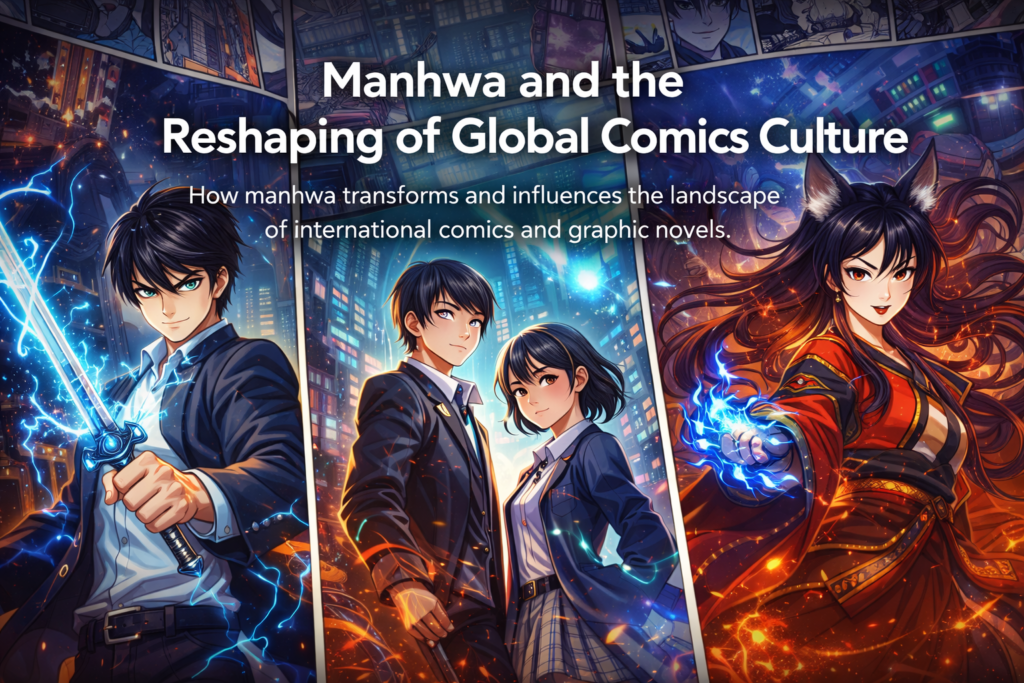
Manhwa and the Reshaping of Global Comics Culture

Manhwa and the Reshaping of Global Comics Culture

Manhwa has emerged as one of the most transformative forces in contemporary visual storytelling. Originating in South Korea, it has evolved far beyond its regional roots, positioning itself as a central pillar of the global comics ecosystem. This rise is not driven by novelty alone, but by a convergence of narrative innovation, digital fluency, and cultural adaptability that few mediums have achieved with such consistency.

At a structural level, manhwa aligns seamlessly with modern consumption habits. Designed predominantly for digital platforms, its vertical-scroll format reimagines how stories are read and perceived. Panels flow downward with deliberate rhythm, replacing rigid page turns with a continuous visual descent. This creates a sense of momentum. A sense of inevitability. Readers are pulled forward, often without realizing how much time has passed.

Narrative Elasticity and Thematic Range

One of manhwa’s defining strengths lies in its narrative elasticity. Genres are not treated as fixed containers …

Top 10 Manga You Must Read: The Ultimate Guide for Every Manga Fan

Manga has become a global storytelling powerhouse. From action-packed adventures to emotional dramas, Japanese manga offers worlds that feel alive and characters that stay with you long after you turn the last page. Whether you’re new to manga or a longtime reader looking for your next obsession, these ten titles represent some of the best the medium has to offer.

Here are ten manga you absolutely must read — along with what makes each story special.


1. One Piece – A Grand Adventure Across Endless Seas

Eiichiro Oda’s One Piece is more than just a pirate story. It’s a massive journey about freedom, friendship, and chasing impossible dreams.

The story follows Monkey D. Luffy, a cheerful young pirate with a rubber body and an unbreakable spirit. His goal is simple: find the legendary treasure called One Piece and become the King of the Pirates. Along the way, he gathers a …

Mapping the Manga Landscape

Manga is not a monolith. It is an expansive narrative ecosystem composed of genres that reflect diverse emotional registers, cultural preoccupations, and storytelling traditions. For newcomers, this breadth can feel overwhelming. Yet it is precisely this variety that makes manga so accessible and enduring. Understanding Manga Genres Every New Fan Should Know provides a practical entry point into a medium defined by both specialization and hybridity.

Shōnen: Energy, Growth, and Determination

Shōnen is often the first genre encountered by new readers. Targeted primarily at younger audiences, it emphasizes action, friendship, and personal growth. Protagonists are typically aspirational figures who evolve through effort, failure, and resilience.

Narratives in this genre rely on escalating challenges and clearly articulated goals. Training arcs, rivalries, and climactic confrontations form a familiar rhythm. Yet beneath the kinetic surface lies a consistent moral framework centered on perseverance and loyalty.

Shōnen’s accessibility and emotional clarity make it a …

The Narrative Velocity of Manga

Manga operates with an immediacy that few storytelling mediums can rival. From the first page, readers are often pulled into a narrative current that moves swiftly and decisively. This is not accidental craft. It is a refined narrative discipline built on decades of experimentation, audience feedback, and cultural intuition. To understand How Manga Storytelling Hooks Readers Fast, one must examine the mechanics that govern its pacing, structure, and emotional delivery.

Immediate Immersion Through Visual Economy

Manga rarely wastes time on exposition-heavy openings. Instead, it leverages visual economy to establish tone, conflict, and character in a matter of panels. A glance. A gesture. A sudden disruption of normalcy. These visual cues provide context without explanation, allowing readers to infer rather than be instructed.

This approach respects the reader’s intelligence. It creates participation. Rather than being told what matters, readers feel it instinctively. The result is rapid immersion, where curiosity activates …

The Visual Alchemy of Manga

Manga is not merely a storytelling medium. It is a visual philosophy. Across decades of evolution, manga has cultivated an astonishing diversity of art styles, each with its own emotional cadence and symbolic grammar. These styles do more than decorate narratives. They shape perception, dictate mood, and imprint themselves on cultural memory. Understanding Manga Art Styles That Instantly Stand Out requires attention to line, rhythm, composition, and the psychological effect of visual exaggeration.

Expressive Minimalism and Emotional Precision

One of the most recognizable manga aesthetics is expressive minimalism. Clean lines. Sparse backgrounds. Faces that carry disproportionate emotional weight. This style strips away excess detail to foreground feeling. A single sweat drop, a widened pupil, or a subtle tilt of the mouth communicates volumes.

This approach thrives on economy. By reducing visual noise, the reader’s focus is guided toward internal states rather than environmental realism. It is particularly effective in slice-of-life …