A Medium Reborn Through Digital Transformation

For much of its history, manhua existed in the shadows of global comics discourse. Rooted in print traditions and constrained by regional circulation, its reach was once limited. That reality has shifted dramatically. The contemporary landscape reveals The Rise of Manhua in the Digital Era as a defining moment not only for Chinese comics, but for visual storytelling worldwide.

This transformation did not occur overnight. It emerged through technological alignment, narrative recalibration, and cultural confidence converging at the right moment.

Digital Platforms as Structural Catalysts

The migration from print to digital platforms altered manhua at a foundational level. Online distribution dismantled geographic barriers, enabling instant access for global audiences. Stories no longer waited for translation pipelines or physical publication cycles.

Vertical scrolling formats optimized for mobile consumption became the new standard. Episodes were released frequently, cultivating habitual reading patterns. Discovery became algorithmic rather than accidental.

This infrastructure favored consistency, adaptability, …

Manhwa and the Architecture of Visual Impact

Manhwa has become a defining force in contemporary visual storytelling, not solely because of its narratives, but because of its unmistakable visual authority. The medium speaks through color, composition, and rhythm with a precision that feels engineered for modern perception. This phenomenon is best understood through The Visual Power Behind Popular Manhwa, where art is not an accessory to story, but its structural backbone.

Unlike traditional print comics, manhwa is conceived with screens in mind. Every visual decision reflects an understanding of digital ergonomics. The result is an experience that feels immersive, fluid, and psychologically calibrated.

Digital Composition and Vertical Flow

The vertical-scroll format fundamentally reshapes visual composition. Panels are no longer confined to rectangular symmetry or page boundaries. Instead, they exist within a continuous spatial axis. This allows images to breathe. Motion unfolds downward. Time stretches visually.

A falling character may descend across multiple frames, elongating tension. A …

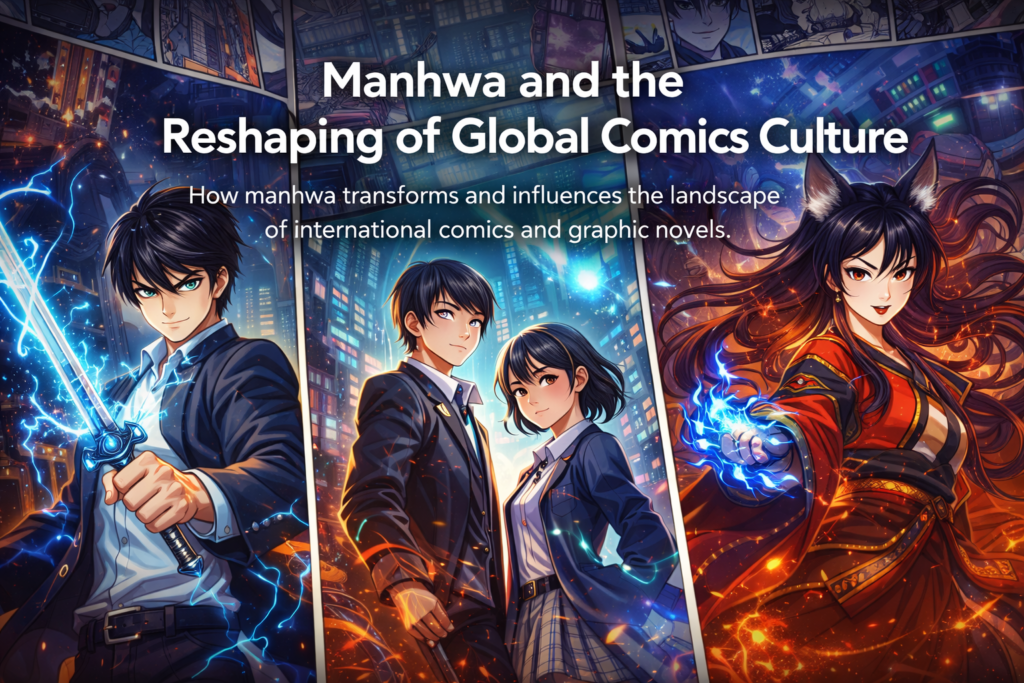
Manhwa and the Reshaping of Global Comics Culture

Manhwa and the Reshaping of Global Comics Culture

Manhwa has emerged as one of the most transformative forces in contemporary visual storytelling. Originating in South Korea, it has evolved far beyond its regional roots, positioning itself as a central pillar of the global comics ecosystem. This rise is not driven by novelty alone, but by a convergence of narrative innovation, digital fluency, and cultural adaptability that few mediums have achieved with such consistency.

At a structural level, manhwa aligns seamlessly with modern consumption habits. Designed predominantly for digital platforms, its vertical-scroll format reimagines how stories are read and perceived. Panels flow downward with deliberate rhythm, replacing rigid page turns with a continuous visual descent. This creates a sense of momentum. A sense of inevitability. Readers are pulled forward, often without realizing how much time has passed.

Narrative Elasticity and Thematic Range

One of manhwa’s defining strengths lies in its narrative elasticity. Genres are not treated as fixed containers …

The Enduring Relevance of Comics in a Connected World

Comic books have survived wars, censorship, technological revolutions, and shifting cultural tastes. Many predicted their decline with the rise of television, video games, and digital media. Yet comics persist. Not quietly, but confidently. To understand Why Comics Still Matter in the Digital Age, it is necessary to examine how this medium continues to evolve while preserving its core narrative power.


Comics as a Unique Narrative Medium

Comics occupy a rare intersection between literature and visual art. They are not merely illustrated stories. They are sequential experiences. Meaning is created not only through dialogue and imagery, but through pacing, layout, and the silent spaces between panels.

This structure invites active participation. Readers do not passively consume comics; they interpret them. The mind bridges gaps, imagines motion, and supplies emotional resonance. In an era dominated by autoplay videos and algorithm-driven feeds, this participatory quality gives comics a distinctive cognitive and artistic …