A Global Language Told Through Panels

Once rooted firmly in Japanese publishing culture, manga has expanded far beyond its geographic origins. What began as a domestic storytelling medium has become an international cultural force, shaping creative industries, influencing social discourse, and redefining how stories are visually consumed. This expansive reach is best understood through The Cultural Impact of Manga Worldwide, a phenomenon that continues to evolve with each new generation of readers.

Manga is no longer regional. It is global.

From Local Tradition to Global Phenomenon

Manga’s visual grammar emerged from a unique blend of traditional Japanese art, postwar influences, and serialized storytelling. Early works reflected domestic concerns, cultural norms, and historical memory.

Over time, however, universal themes began to dominate. Identity. Conflict. Love. Loss. Aspiration.

These themes transcended language barriers. Translations proliferated. International publishers invested. Digital platforms accelerated access.

Manga crossed borders not by abandoning its origins, but by remaining authentic to them.

This …

» Read more
A Medium Awakening on the World Stage

Once confined largely to domestic audiences, manhua has undergone a remarkable transformation. What was once perceived as a regional form of visual storytelling has now emerged as a global cultural force. Digital distribution, aesthetic reinvention, and thematic expansion have converged to explain Why Manhua Is Exploding Across Global Comics, reshaping reader expectations and redrawing the map of sequential art.

This ascent is neither sudden nor accidental. It is the result of long gestation meeting the right technological moment.

Digital Platforms as Accelerators

The global visibility of manhua is inseparable from its digital-native evolution. Online platforms have dismantled geographic barriers that once limited access. Readers across continents now encounter manhua simultaneously, without delay or translation scarcity.

Vertical scrolling formats, episodic releases, and mobile optimization align seamlessly with contemporary reading habits. Consumption becomes habitual. Discovery becomes frictionless.

In this environment, manhua thrives not because it imitates existing models, but because it …

» Read more

Manhwa and Manga in a Global Context

Manhwa and manga are often mentioned in the same breath, grouped together as pillars of East Asian sequential art. Yet beneath this superficial proximity lies a complex divergence in structure, aesthetics, and narrative philosophy. Understanding these distinctions reveals not competition, but contrast. It also clarifies Manhwa vs Manga What Sets Them Apart in a rapidly globalizing comics ecosystem.

Both forms share historical intersections with print culture and visual storytelling traditions. However, their modern expressions reflect different creative priorities shaped by technology, readership habits, and cultural frameworks.

Origins and Cultural Frameworks

Manga developed within Japan’s postwar publishing boom, deeply rooted in serialized print magazines. Its evolution was shaped by rigid publication schedules, black-and-white printing economics, and genre segmentation aimed at specific demographic cohorts. These constraints fostered remarkable efficiency in storytelling, emphasizing clarity, symbolism, and visual economy.

Manhwa, originating in South Korea, followed a more turbulent trajectory. Subject to censorship during much …

» Read more

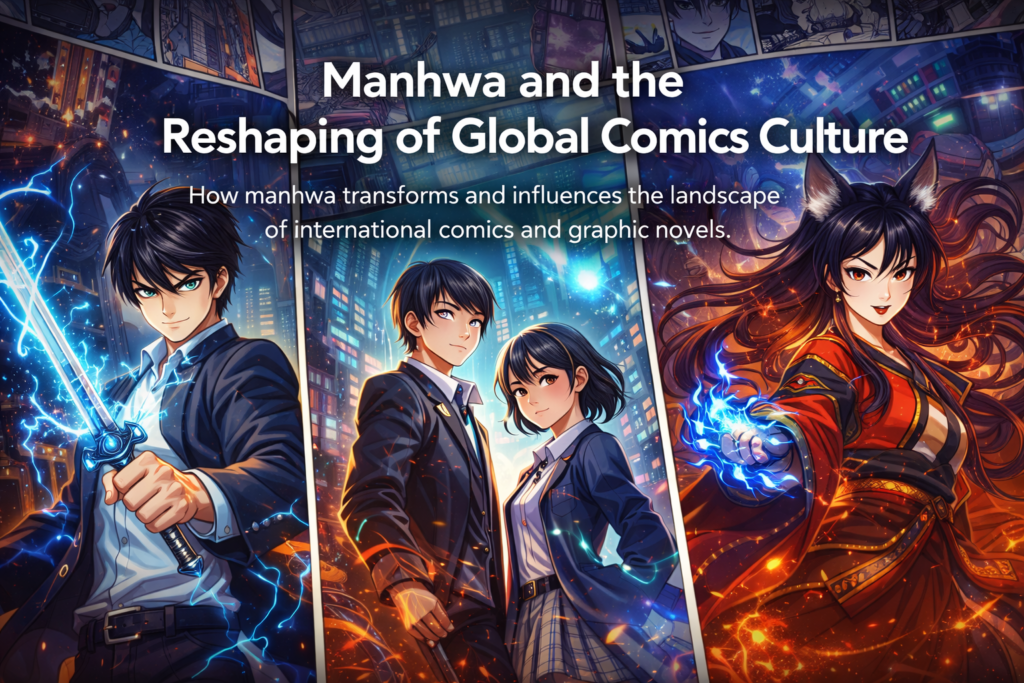
Manhwa and the Reshaping of Global Comics Culture

Manhwa and the Reshaping of Global Comics Culture

Manhwa has emerged as one of the most transformative forces in contemporary visual storytelling. Originating in South Korea, it has evolved far beyond its regional roots, positioning itself as a central pillar of the global comics ecosystem. This rise is not driven by novelty alone, but by a convergence of narrative innovation, digital fluency, and cultural adaptability that few mediums have achieved with such consistency.

At a structural level, manhwa aligns seamlessly with modern consumption habits. Designed predominantly for digital platforms, its vertical-scroll format reimagines how stories are read and perceived. Panels flow downward with deliberate rhythm, replacing rigid page turns with a continuous visual descent. This creates a sense of momentum. A sense of inevitability. Readers are pulled forward, often without realizing how much time has passed.

Narrative Elasticity and Thematic Range

One of manhwa’s defining strengths lies in its narrative elasticity. Genres are not treated as fixed containers …

» Read more

Top 10 Global Comics You Must Read: Manga, Manhwa, Manhua, and Graphic Novels

Comics today are truly global. Great stories now come not only from Japan or the United States, but also from Korea, China, and Europe. Manga, manhwa, manhua, and Western graphic novels each bring their own style, culture, and way of storytelling.

If you’re looking for powerful stories that cross borders, here are ten global comics you should definitely read.


1. Watchmen (USA)

A dark and realistic superhero story set in an alternate timeline where masked heroes exist. Watchmen explores morality, power, and politics, showing that heroes are often just broken people trying to do the right thing.


2. One Piece (Japan – Manga)

Follow Monkey D. Luffy and his pirate crew as they sail across dangerous seas in search of legendary treasure. Beneath the action is a heartfelt story about freedom, friendship, and chasing impossible dreams.


3. Maus (USA / Europe)

This award-winning graphic novel tells a Holocaust survival story …

» Read more